Should I spread my chicken litter in the spring?
Build a spreadsheet that shows which corn fields save money when you spread litter in spring.
Problem: A farm in the Southeast spreads chicken litter in the fall to supply phosphorus (P) and potassium (K). In the spring, it applies nitrogen (N) as UAN in two passes. The farm wants to know if it pays to spread the litter in the spring instead and skip the first UAN pass.
More context: Farmers apply N, P and K fertilizers to their fields every year. In the South, most farmers apply P and K after harvest, when work is slower. They apply N in the spring, in two passes, because winter rain washes away N applied in the fall.
Chicken litter is a popular fertilizer that supplies N, P and K together. Farmers often spread it in the fall and accept that most of the N is lost. If they spread it in the spring instead, its N can replace the first UAN pass. That means less wasted N, less soil compaction and less wear on the machine. But to supply that much N, spring needs more litter than the P need alone. Spring pays only when the saved pass is worth more than the extra litter.
The best plan for each field depends on its yield, the P already in its soil, and the prices of litter and N. In this tutorial, you build one Excel file for the corn fields of a demonstration farm. At the end, the file shows the best plan for each field and the total you save.
1. List next year's corn fields
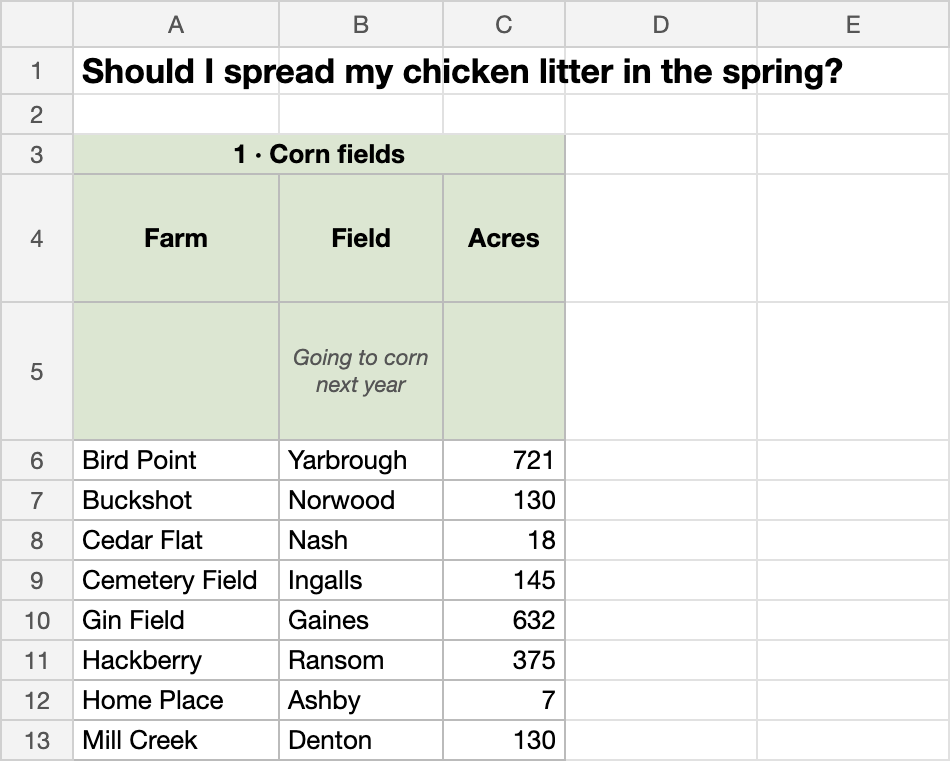
I'm deciding which corn fields get chicken litter this spring instead of this fall. Next year's corn fields are the ones in wheat and double-crop soybeans this year. Start an Excel file with a row for each of these fields, and columns for farm, field and acres.
I found 20 fields in wheat and double-crop soybeans in 2026, 5,031 acres in total.
2. Work out the phosphate need
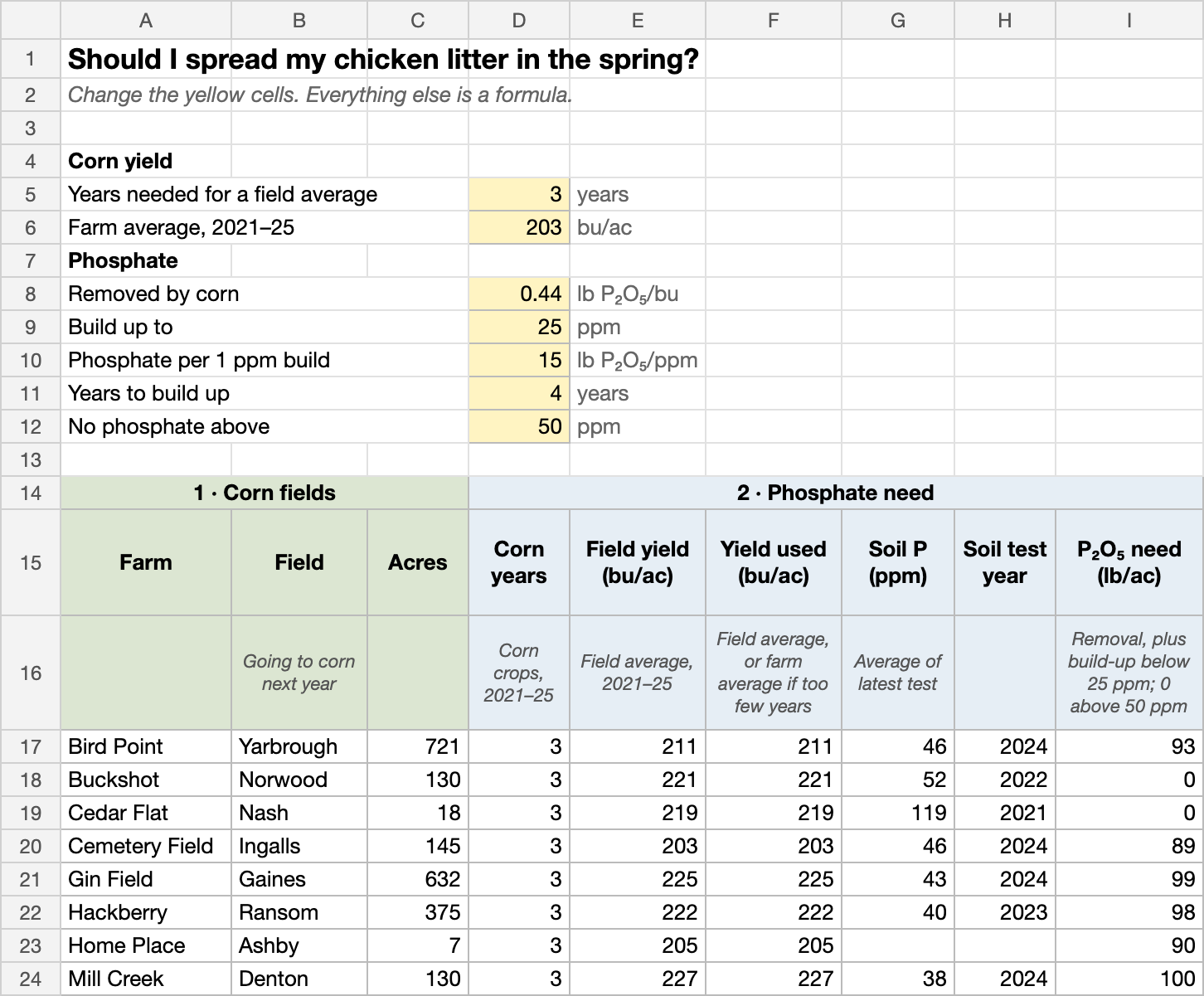
Add a section that works out the P₂O₅ need for each field: 1. Find each field's average corn yield for 2021–25. If a field has fewer than 3 years of corn, use the farm average. 2. Find each field's soil P: the average of all sample points from its most recent test. If a field has no soil test, leave it blank. We'll flag it later. 3. Work out the P₂O₅ need with these rules: - Corn removes 0.44 lb P₂O₅ per bushel. - Below 25 ppm, add 15 lb P₂O₅ per ppm to build up to 25 ppm over 4 years. - Above 50 ppm, apply no P₂O₅. - If a field has no soil test, use removal only. Format the spreadsheet this way: - Put the numbers above in yellow cells at the top, and use formulas that refer to them. - Put a short description under each column header. - Give each section's columns a different color.
The farm averages 203 bu/ac of corn for 2021–25. Garrison has only 2 years of corn, so I used the farm average there. Eight fields test above 50 ppm and need no P₂O₅. Ashby and Mercer have no soil test, so I used removal only.
3. Estimate the cost of fall litter with spring N
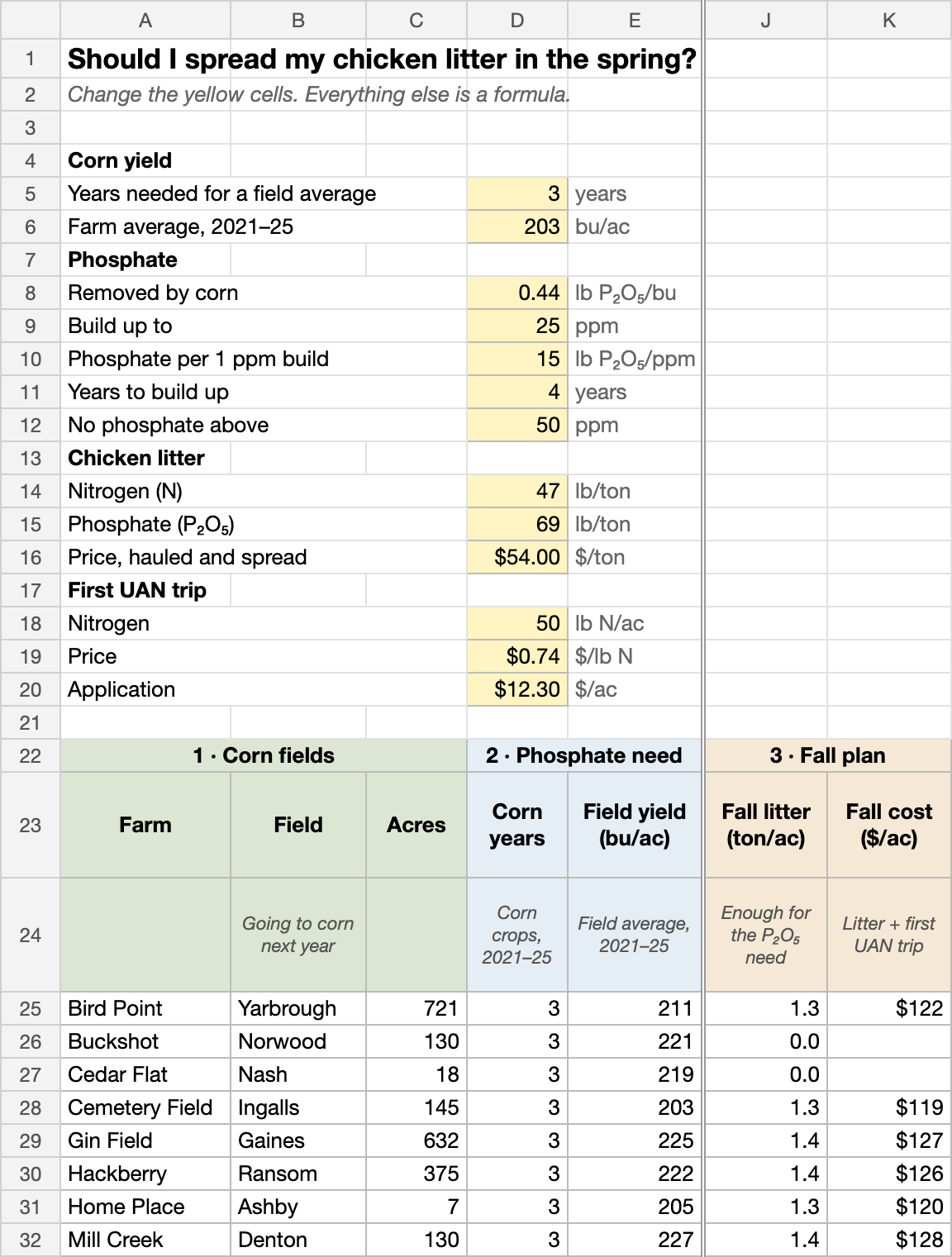
Add a fall plan section. My litter has 47 lb N and 69 lb P₂O₅ per ton, and it costs $54 a ton hauled and spread. My first UAN pass is 50 lb N at $0.74 a pound, plus $12.30 an acre to apply. In the fall plan, I spread enough litter to meet the P₂O₅ need, and I still make the first UAN pass.
The first UAN pass costs $49.30 an acre: 50 lb × $0.74, plus $12.30.
4. Estimate the cost of spring litter in place of N
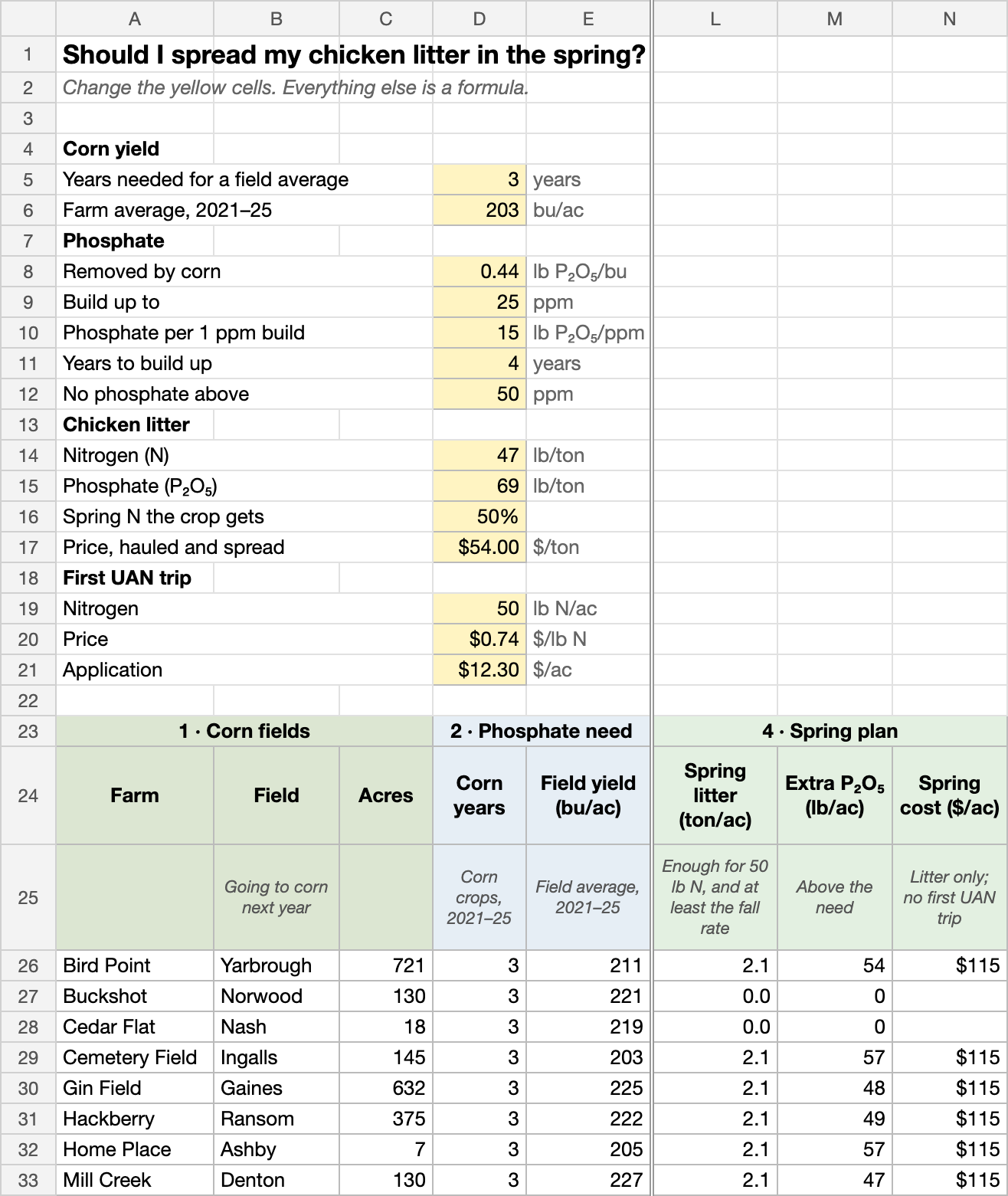
Add a spring plan section. When I spread litter in the spring, the crop gets half of its N. In the spring plan, I spread enough litter to supply the 50 lb N of my first UAN pass, but never less than the P₂O₅ need, and I skip that pass. Fields above 50 ppm get no litter in either plan. Show the extra P₂O₅ that the spring rate adds.
On every field that needs P₂O₅, the spring rate is 2.1 ton/ac: 50 lb N ÷ (47 lb × 50%). This is more than the fall rate on every field, so N sets the spring rate.
5. Compare the plans
Add a section that compares the two plans. Show what spring saves per acre and per field, the litter price at which spring stops paying, and the best plan for each field. Put a short summary at the top.
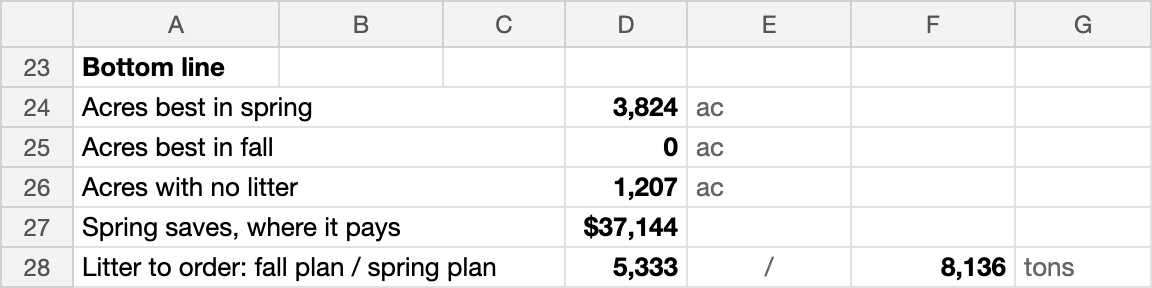
Here is the summary at the top of the sheet:
And the new columns for each field:
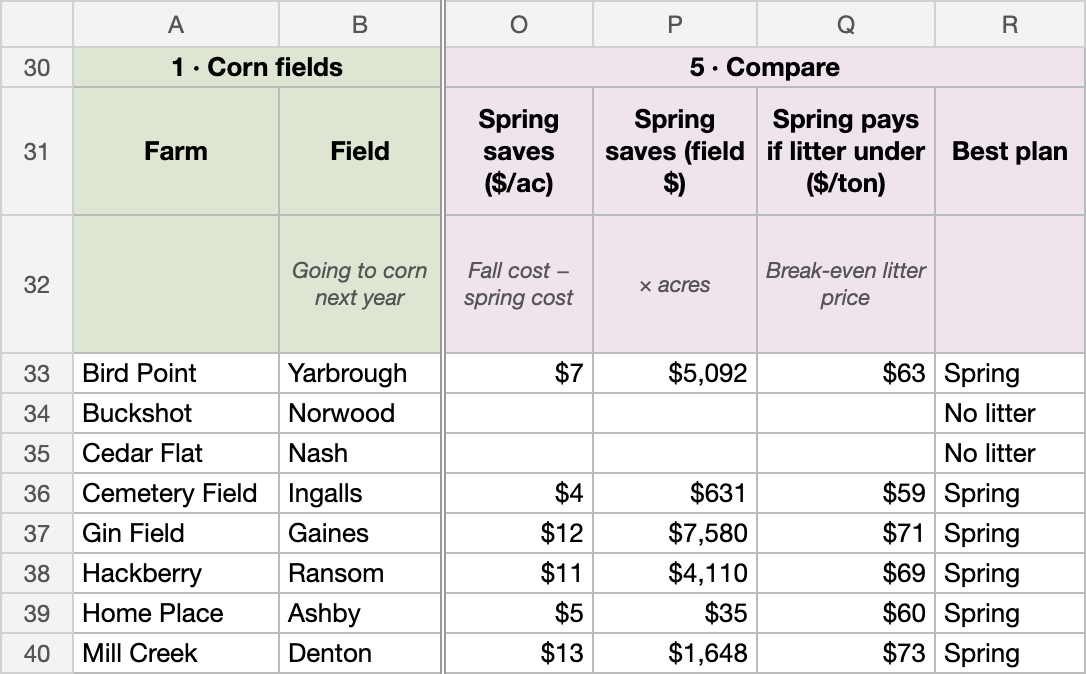
Spring is the better plan on every field that needs P₂O₅. It saves $4 to $23 an acre, and $37,144 in total. The break-even litter price is between $59 and $102 a ton, so if your litter costs more than $59 a ton, some fields switch to fall. The spring plan also needs about 2,800 more tons of litter.
6. Check the data
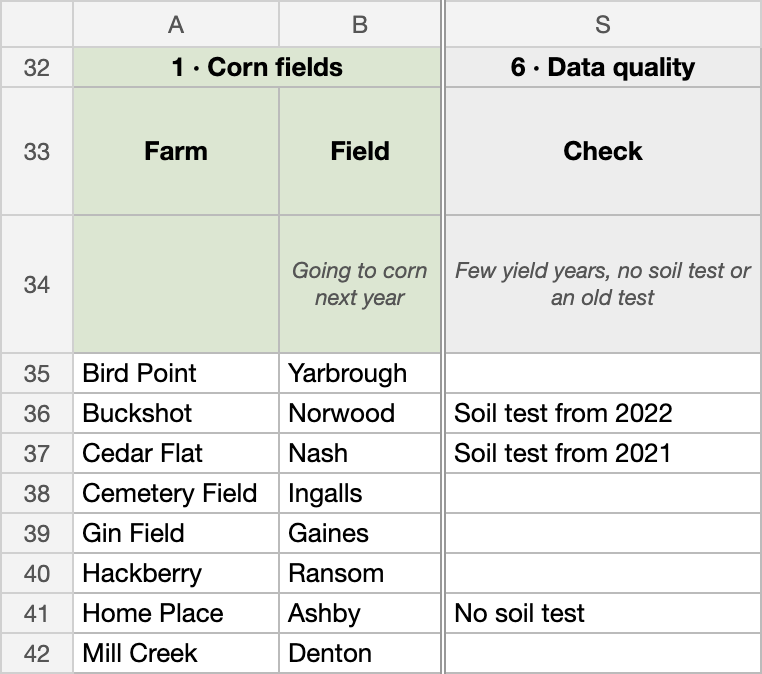
Add a data quality column that flags fields with fewer than 3 years of corn, no soil test, or a soil test more than 3 years old. Then give me the file.
Five fields have a flag. Garrison has only 2 years of corn. Ashby and Mercer have no soil test. Norwood and Nash were last tested in 2022 and 2021.
7. Make it yours
Example workbookThis is the workbook for the demonstration farm. Change the yellow cells at the top, and every other number updates.
Stay in the same chat to ask more questions, for example:
- "Change the litter price to $65 a ton. Which fields switch to fall?"
- "My first UAN pass is 60 lb N. Does spring still pay?"
- "Build up soil P over 8 years instead of 4. How much less litter do I need?"