Daily Planting Reports
Analyzing growers' planter performance every day of planting so they can achieve the best possible stand.
Daily Planting Reports
Analyzing growers’ planter performance every day of planting so they can achieve the best possible stand.
The gist
- Our system analyzed and summarized our growers’ planter performance every day they planted.
- It caught things like:
- A planter double-logging its coverage map because of bad display settings.
- An operator driving with inconsistent speeds causing planting errors.
- An operator ignoring an overplanting row unit.
- An underplanting row unit that benefited from a rebuild.
- Suboptimal vacuum settings for seed size and shape.
The story
We connected several growers’ Ops Centers to automatically stream data into our system. Then once a night, we had our system analyze the planting performance from the day; searching for patterns and anomalies. In the morning, a summarized brief was sent to the growers.
What it found
Double data logging
An operator incorrectly set up their tractor display, causing the display to log twice as many datapoints as it should have.
This caused their Ops Center AsApplied planting map to be corrupted, reporting twice as many acres and half the actual seeding rate as it should have. A surprisingly annoying problem given the grower has downstream software that uses these Ops Center numbers to generate insurance reports.
Here’s an excerpt from the report:
Frankie’s drill is double-logging planting
Ops Center reports 178 acres on Plank Pivot today. The ground Frankie actually covered is about 89 acres.
178 acres in 3.87 active hours at 40 ft implement width would require the tractor to travel 9.5 mph. Frankie’s average speed today was 5.1 mph with a 7.2 mph max. The 178 acres number doesn’t fit. 89 acres does.
The raw John Deere log has every second recorded twice, once from the tractor’s Gen4 and once from the implement. Both are configured to log planting as independent sources. Ops Center reads the log and sums, so 178 is really 89.
Acres Ops Center reports 178 Actual ground covered 89
The grower was not aware of the problem, and immediately worked with the operator to adjust the display settings and stopped the double-logging.
An operator with inconsistent speeds
One day the system noticed planter error was shifting between ±2% when on previous days the error was between ±1%.
The system dug further and noticed a pattern: the planter kept changing speeds between 8 and 12 mph, and these speed differences were strongly influencing the planting error. If the planter drove at 12 mph it overplanted by 2%. If it drove at 8 mph, the planter underplanted by 2%. At 10 mph, it had 0% error. The report informed the grower of the pattern it saw.

We later learned the grower was planting that day instead of his usual planter operator. The grower said he just wasn’t paying attention and wasn’t thinking much about planting speed. He wasn’t aware it made that big of a difference in his planting error and joked, “I guess that’s why I pay somebody better than me to operate the planter.”
An operator who ignored an overplanting row unit
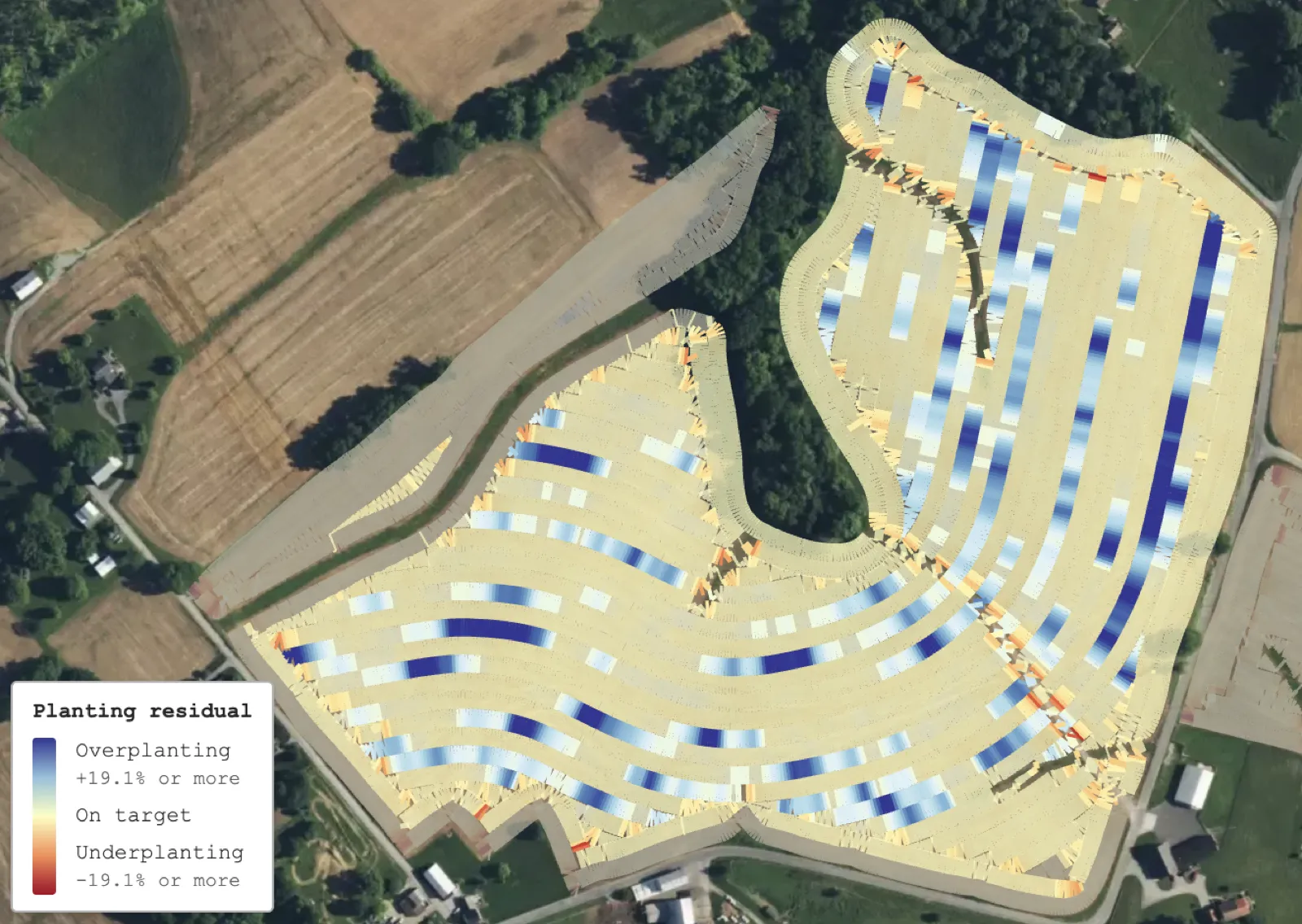
One afternoon, a planter started having a row unit intermittently overplant. The operator seemingly ignored the errors on the planting monitor and planted the rest of the day with the bad row unit.
Our system flagged the overplanting events to the grower who inspected the planter, found the problem row unit, and fixed a broken part.
| Map of where the planter overplanted (yellow normal, blue overplanting) |
|---|
 |
The grower also kept track of the field where the problem occurred, verified the problem was real, and used it as a coaching opportunity for the operator.
| Verified overplanting after corn emergence |
|---|
 |
A silently underplanting row unit
One of our growers had a row unit that was consistently underplanting by 2%. Not a huge error, but an easy fix.
His Ops Center data was high enough resolution that we could identify the exact row unit and error, so when he received our report, he immediately investigated the row unit, disassembled it, cleaned it, and it was back up and running with no error.
| Row unit 15 consistently underplanting by 2% through the day |
|---|
 |
Suboptimal vacuum settings
Most of the errors we caught were related to matching seed size and shape to vacuum settings. The wrong vacuum pressure for a certain seed size and shape means overplanting or underplanting by a small percentage. Not a huge issue, but one that can compound over many acres, and an easy setting tweak to fix.
Here’s an example timeline of a planter that shows error drift from 0% to overplanting by 1% likely from the variety change from DKC 116 to DKC 122.
| Planter overplanting more with new variety, should decrease vacuum pressure |
|---|
 |
The future
These planting reports were interesting and thought-provoking, but they didn’t drive as much action this year as they could. The most notable limiting factor was they ran at a frequency of once a night. Any errors would only be caught when the report ran later that night, which meant oftentimes the operators caught the errors before our system could.
In the future, we’re building the infrastructure to run this live on the grower’s Ops Center, catching errors as fast as the data is uploaded.